

What happened?
I lived through a motor vehicle accident in December 2022 in Portland, Oregon, USA.
Unsurprisingly, I missed my flight back home to New York City two days after the accident.
Still, I lived!
Though, I couldn’t celebrate that fact right away. First came several months of hospitalization, numerous legal battles, confrontation of a painful new reality filled with loss, an emotional, social, financial, and physical rebirth, and a (thankfully, temporary) discoloration of my achievements and goals.
The most severe of my resulting injuries was a Traumatic Brain Injury (TBI), which continues to impair my mobility, primarily.
Doctors and surgeons delivered me to health by immediately treating a plethora of other injuries (below, as documented in MyChart), minor by comparison.

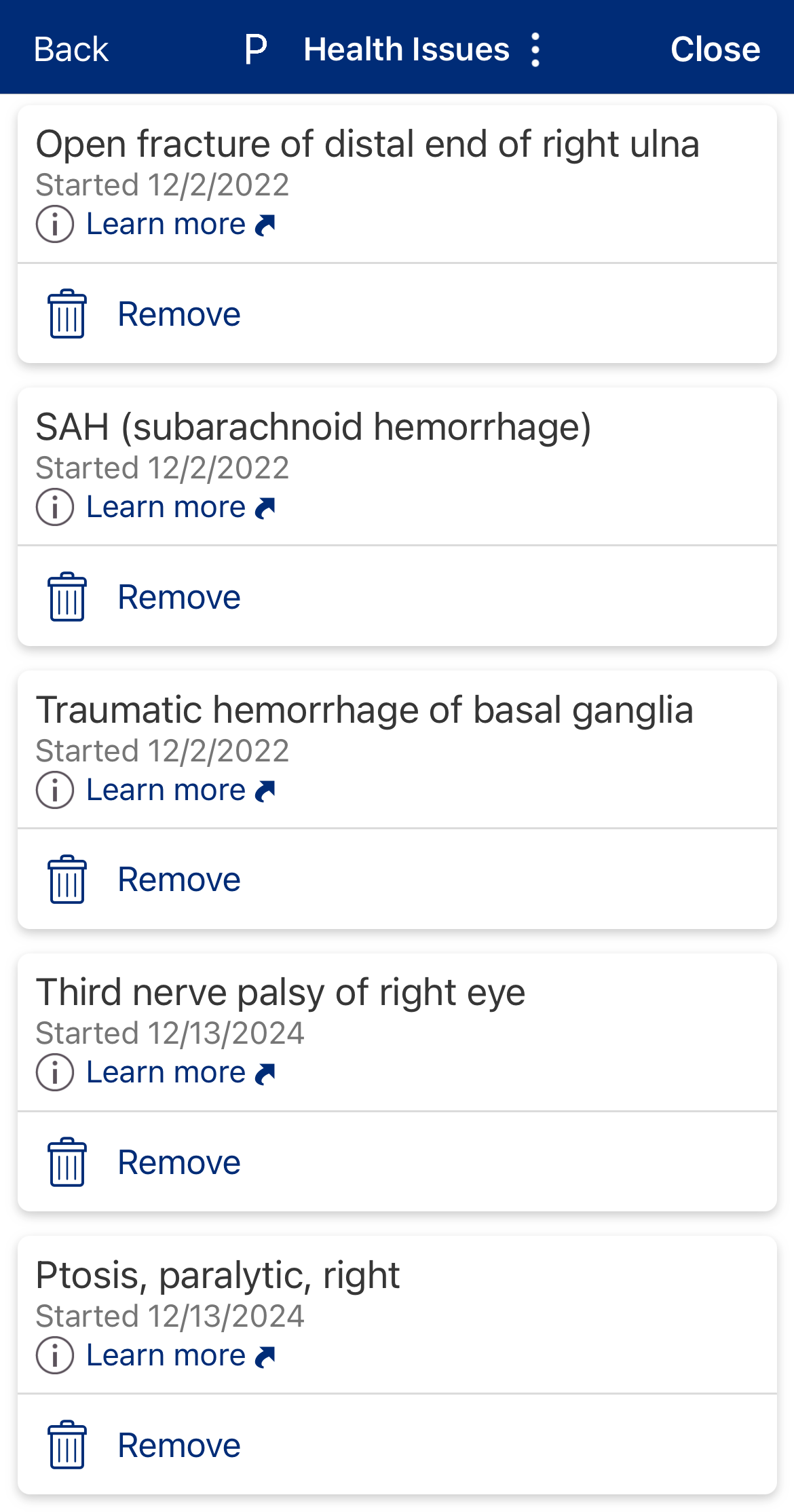

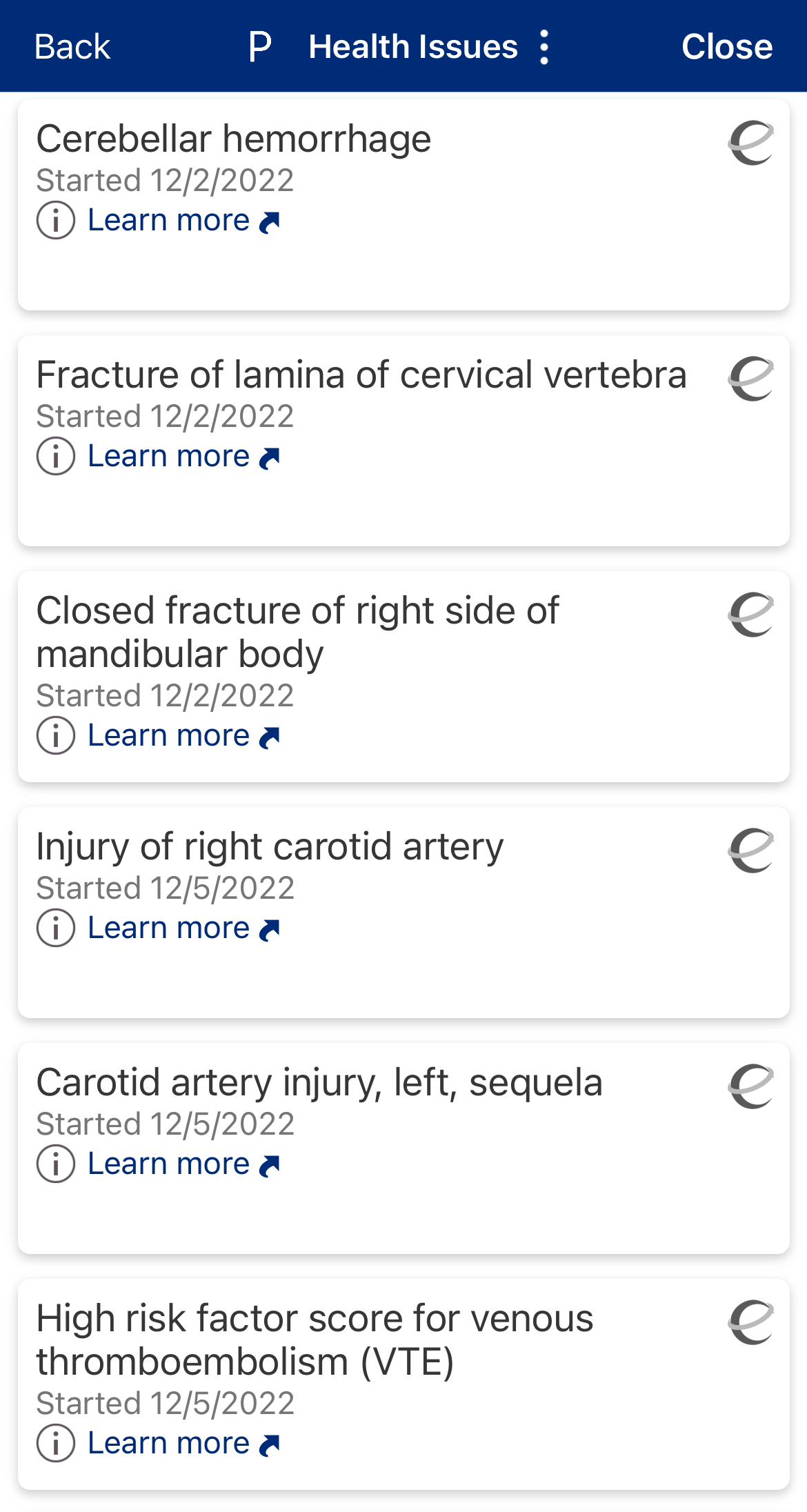
Disclaimer: Clicking “Remove” erases a listed condition from the tracking application; it does not free the patient of the associated symptoms.
Not Listed: Anosmia, loss of the sense of smell.
My injury’s less-than-medical consequences demand to be felt to this day.
I now reside with my family in our home in Maryland, while actively engaging in rehabilitation.
I’ve lost many friends, parted from my then-partner, and, heartbreakingly, learned that my recovery is optional for many.
My sphere of pastimes is limited to stationary activities. No mini-golfing; no bowling.
A hostile work-environment led to my resignation as a Product Manager, a title that I aim to reclaim.
What now?
Now, we adapt. We advocate for accessible healthcare and accommodations for fellow survivors.
We are patient, despite our mothers’ assertion that we did not inherit the ability to be. 😅
We share our observations on patterns in recovery at BIAMD’s annual conference.
We consider a range of conditions and symptoms, represented by peers within NCHPAD, in our advocacy.
BIAMD: Survivor Story
Surviving is only the beginning.
Then comes living.
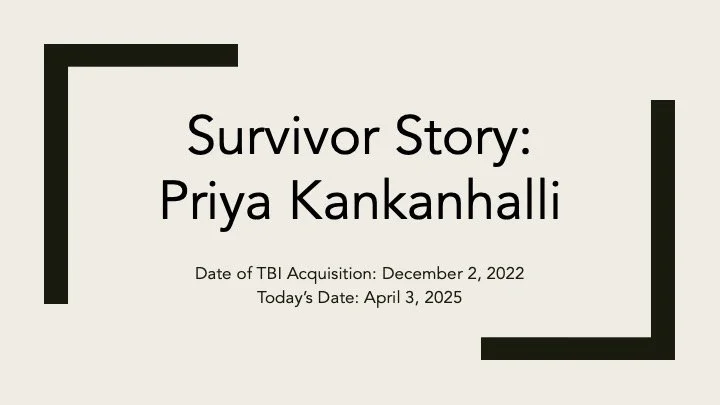
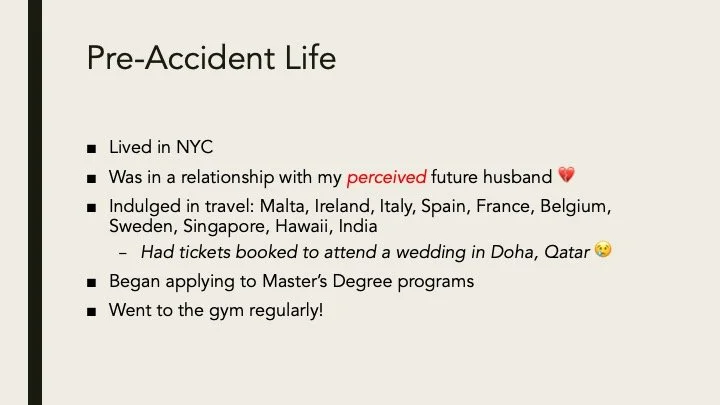
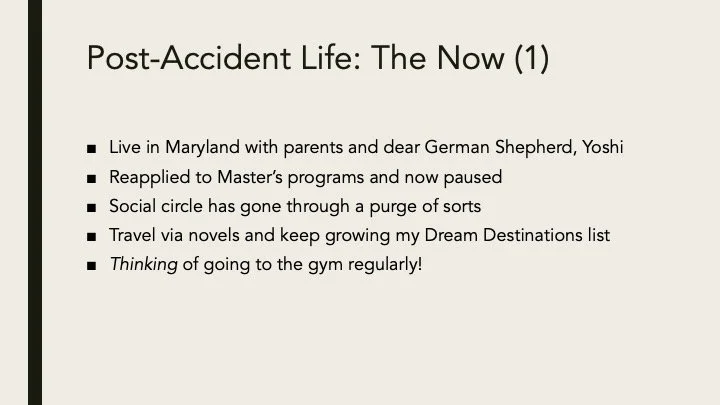
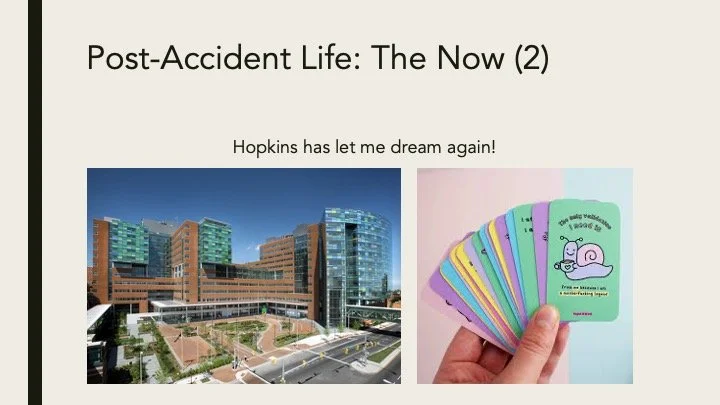
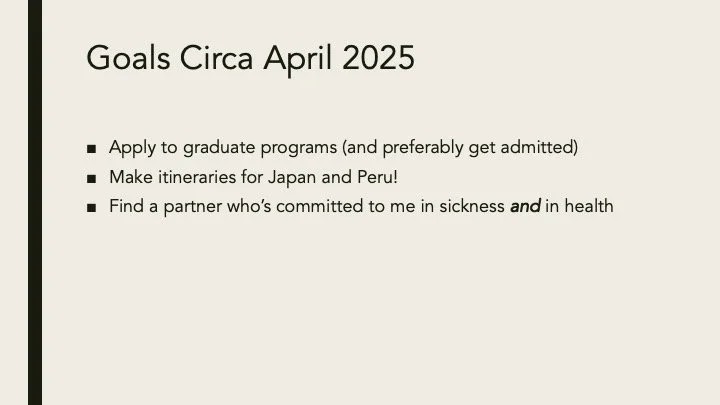
Living requires amassing support and creating space for solidarity. My then-OT and then-PT extended me the opportunity to find solidarity by telling my story at BIAMD’s Annual Conference in 2025. I told my story through a presentation concentrated on my pre-accident and post-accident lives.
NCHPAD: Tuesday Talk Time
Where there is suffering, there is opportunity for teaching.
NCHPAD members, sharing informative, bimonthly presentations on their recovery arcs, had lots more to teach after hourlong deep-dives in Coffee Club, no matter how deep the dive. So, Tuesday Talk Time was born!
On a quarterly basis, those interested are invited to informally teach and establish camaraderie while deliberately reflecting and opining on unifying topics on Zoom. No longer tethered to pre-set presentations, attendees are prompted to respond freely to universal topics in healthcare, whether with anecdotes or with questions. Tuesday Talk Time multiplies the number of speakers in a session, the lessons, and ultimately, the peer-to-peer learning.
Past Topics:
August 2026
How do we help friends, family, or others understand our limitations while also setting healthy boundaries? What has helped communicate needs with confidence?
December 2026
What does it mean to rediscover our purpose after disability? How do we find new meaning, embrace personal growth, and discover possibilities we may never have imagined?
PK: Priya Kankanhalli, v2.0
Initially, my condition required continuous medical intervention, but I now qualify for outpatient care. Today, medical intervention is sporadic, and I am the captain of my own recovery!
I am guided by these principles in pursuing modified high-performance everyday:
Repeat to learn.
Repetition is avoided in professional settings, but it is encouraged when attempting to move conscious processes into the subconscious mind.
So, every morning and evening, I repeat a set of exercises prescribed by my Physical Therapist.
Repetition has helped me learn balance strategies and techniques for safe falling!
Stay active.
I’m not running marathons, but my neurons have stayed active through my service as CCMD’s Big Red Bookcase Coordinator, as Zia’s English tutor, completing coursework, writing, and polishing this very portfolio!
Harvard Business School Online newly attests to my proficiency in core business essentials, and comedy/satire publication Robot Butt pays homage to my migration to suburbia with a reflection on How the Suburban Half Lives.
Be goal-oriented.
Purpose, rather than a diamond, is now my best friend.
Whether my goal is to buy nail polish remover today, to revise my Personal Statement this week, or to build stamina for BIAMD’s 1-Mile Walk next month, goals are inherent time capsules, concentrate my efforts, and prevent hurtful speculation.
Lofty goals like traveling to Japan are permissible!
You didn’t hear it from me!
You heard it from Suleika Jaoud, fellow survivor and author of Between Two Kingdoms.
Universal themes in recovery from illness or injury in early adulthood:
Isolation / Loneliness / Exodus of Peers
Distinct Pre- vs. Post-Illness Lives
Frustration with Articulating Limitations
Muddled Root vs. Surface Targets of Anger
Coexistence of Guilt and Irritation
Awareness of Fortune Alongside Inequity
Anticipation Mingled with Fear of the Future
Pursuit of Creative Projects
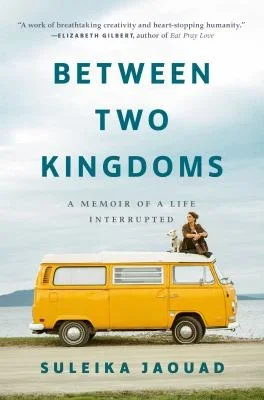
More on Mental Battles
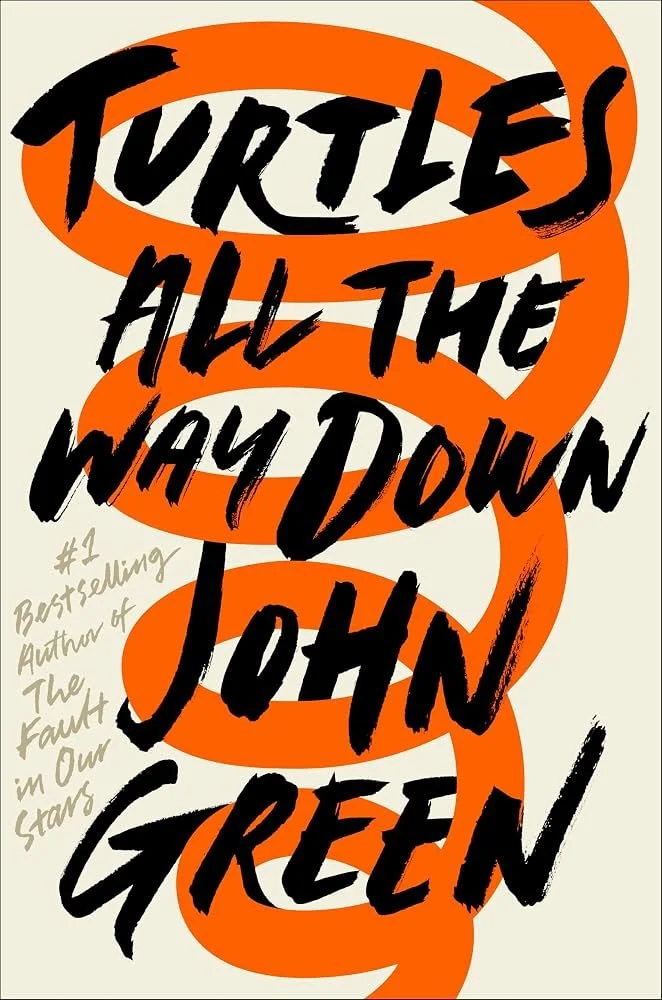
286 gripping pages more, precisely.
John Green explores the isolation, dysfunction, and smallness that follow the protagonist of Turtles All the Way Down, Aza Holmes, as she wrestles with Obsessive-Compulsive Disorder.
Spoiler alert! Ultimately, Aza rises above her OCD to solve the disappearance of a billionaire.
“What’s past is prologue.”
—William Shakespeare, The Tempest
—Russell Davis Pickett, Jr., Personal Blog